SCHANNEL event logging

First, my thanks to Bhuvnesh Kumar for his help!


Time to figure out what’s going on behind the curtain!


Are you seeing System Event Log, Event ID 36871 events?


Why does this matter?


Depending on OS versions and patches, the TLS Cipher Suites may not match on the various SCOM servers.

  1. If you’re setting up TLS1.2, you need the SCOM servers to talk
  2. The bad part, is this isn’t logged much on the GW but log more often on MS
  3. Sometimes the 36871 events come with 36874, but in my experience they occur after Event Logging is enabled.


The unanswered question is “why are we seeing the 36871 events?”


In my example, the events only happened once a day, roughly 24 hours


Event Viewer


Are events related to the Cipher Suite, or is it a MP trying to run the old SQLOLEDB method?


This article will focus on verifying Cipher Suite on a server

See this article for MP analysis for SQL methods


SCHANNEL event logging setup


From Holman’s blog

DecimalDescription
0Do not log
1Log Error messages
2Log Warnings
3Log Error and Warning messages
4Log Informational and Success events
5Log Error, Informational and Success events
6Log Warnings, Informational and Success events
7Log Everything (Warnings, Errors, Informational and Success events


I’d recommend setting it to 3 to see errors and warnings, or 7 to see everything.

Remember to set this back to 1 when done resolving any issues.


Add

From Command Prompt or PowerShell (as administrator)

reg add “HKLM\SYSTEM\CurrentControlSet\Control\SecurityProviders\SCHANNEL” /v “EventLogging” /t REG_DWORD /d 7 /f

Disable

reg delete “HKLM\SYSTEM\CurrentControlSet\Control\SecurityProviders\SCHANNEL” /v “EventLogging”

Verification

reg query “HKLM\SYSTEM\CurrentControlSet\Control\SecurityProviders\SCHANNEL” /v “EventLogging”


PowerShell verification

RegEdit Verification

Time to reboot!


Verify SCHANNEL events

Look at the System Event log, and filter for 36880 and 36874 events for clues


36880 provides Cipher Suite details


Event ID 36874 definitely describes the scenario


The easy answer to solve the cipher suite is to ask – is this server patched with latest security and .NET patches?

After all this, in my example, we confirmed that simple step was assumed, and inaccurate.


References
36871 event https://docs.microsoft.com/en-us/previous-versions/windows/it-pro/windows-server-2012-R2-and-2012/dn786445(v=ws.11)

SCHANNEL events https://docs.microsoft.com/en-us/previous-versions/windows/it-pro/windows-server-2012-R2-and-2012/dn786445(v=ws.11)

SChannel error codes https://docs.microsoft.com/en-us/windows/win32/secauthn/schannel-error-codes-for-tls-and-ssl-alerts

SChannel events https://docs.microsoft.com/en-us/previous-versions/windows/it-pro/windows-server-2012-R2-and-2012/dn786445(v=ws.11)

SSL errors https://www.experts-exchange.com/questions/28996780/event-id-36871-Schannel.html

Troubleshooting https://docs.microsoft.com/en-us/iis/troubleshoot/security-issues/troubleshooting-ssl-related-issues-server-certificate

SQL native client for TLS1.2

Ever try to talk to someone when language is a barrier?


Sure, we can run an app, or search our phrase to pronounce, but it’s so much better when we can communicate seamlessly.


Post TLS1.2 for SCOM

Let’s talk SQL

Part of TLS1.2 is updating SQL Native Client to talk using a secure client that uses TLS1.2

That means a different executable should be called.


Why is that important in SCOM?

Maybe you have management packs that connect to SQL or run external commands.


On MS, there are multiple clues for various errors on Management Packs that use SSL or talk to SQL via a non-TLS method.  NOTE this may mean that the SQL DB that management pack is connecting to may need the same pre-req SQL updates to a TLS 1.2 enabled version.

  1. Do you have custom SQL queries being run, CMDB get’s, OLE DB Data Source checks?
  2. Any Event ID 1401 or 11854 events in the Operations Manager Event log?
    1. These events identify management pack scripts creating SCHANNEL events
      a. Event ID 1401 event example


Cause

SQLOLEDB connection strings will cause 36871 Sytem Log events


Example (TLS1.0)
sConnectString = “PROVIDER=SQLOLEDB;DATA SOURCE=<databaseServerFQDN>;DATABASE=MSSQLSERVER;trusted_connection=yes”
 SQLNCLI11 driver for TLS1.2 connection strings

Example (TLS1.2)
 sConnectString = “Provider=SQLNCLI11;DATA SOURCE=<databaseServerFQDN>;DATABASE=MSSQLSERVER;trusted_connection=yes”


Identify
Look for management packs with SQLOLEDB as the Connect string to reduce 36871 SCHANNEL events

In Windows Explorer, use the Advanced Options dropdown to select File Contents
In the Search bar (top right), enter SQLOLEDB (example shows SQLNCLI11)
NOTE SQL Discovery group pack IS compliant


In Windows Explorer, use the Advanced Options dropdown to select File Contents
In the Search bar (top right), enter SQLNCLI11


Additional offenders
HP Topology MP
SQL 2005 discovery MP (discontinued)
SQL Addendum MP’s (will work to update these with Holman)
SharePoint Foundation server (v15.0.4557.1000)
PRE TLS Microsoft.SystemCenter.2007


Resolution
Unseal (if necessary), update connection string, and reimport management packs
If Sealed vendor MP, request new MP via support Incident (and/or UserVoice if Microsoft sourced pack)
If Vendor will not release MP’s, accept risk with the logged errors, update MP, or remove from SCOM


Set up SCOM 2016 for TLS1.2

Security bugging you about SCOM using TLS1.0 ?


Have questions on the TLS1.2 Protocol Support Deployment guide link?

If using ACS, please review ACS steps to configure from the guide above


It’s time to update SCOM 2016 to TLS1.2!


Pre-requisites

.Net and SQL native client, ODBC must be updated to TLS1.2 compliant version

HTTPS Endpoints must be CA signed certificates using SHA1 or SHA2


Ensure .Net version 4.6 is installed on all SC components

Determine which .Net is installed https://docs.microsoft.com/en-us/dotnet/framework/migrationguide/how-to-determine-which-versions-are-installed

From PowerShell (run as admin is NOT required)

Get-ChildItem ‘HKLM:\SOFTWARE\Microsoft\NET Framework Setup\NDP’ -recurse | Get-ItemProperty -name Version,Release -EA 0 | Where { $_.PSChildName -match ‘^(?!S)\p{L}’} | Select PSChildName, Version, Release


Above commands from StackOverFlow article

Guide to .Net versions and dependencies https://docs.microsoft.com/enus/dotnet/framework/migration-guide/versions-and-dependencies


Sample output from win2k8R2 sp1 server (and same from 2016 server)


SQL Server updates

Install the required SQL server update supporting TLS1.2

From PowerShell as Administrator
Invoke-Sqlcmd -Query “SELECT @@VERSION;” -QueryTimeout 3

Example Output
PS C:\Windows\system32> Invoke-Sqlcmd -Query “SELECT @@VERSION;” -QueryTimeout 3
Column1

——

Microsoft SQL Server 2016 (RTM-GDR) (KB3210111) – 13.0.1728.2 (X64) …

OR

Microsoft SQL Server 2008 R2 (SP2) – 10.50.4000.0 (X64)


Compare to SQL matrix to download and install appropriate version
TLS 1.2 SQL Support https://support.microsoft.com/en-in/help/3135244/tls-1.2-support-for-microsoft-sql-server
NOTE Verify you are running a compliant cumulative update (CU), you will need the patch (SQL2016 natively supports TLS1.2)
SQL Server 2008R2 SP2 is NOT supported for TLS1.2  https://blogs.msdn.microsoft.com/sqlreleaseservices/tls-1-2-support-for-sql-server-2008-2008-r2-2012and-2014/


Install the required SQL Native Client
FYI – SQL 2016 uses the SQL 2012 Native client
Download link https://www.microsoft.com/en-us/download/details.aspx?id=50402


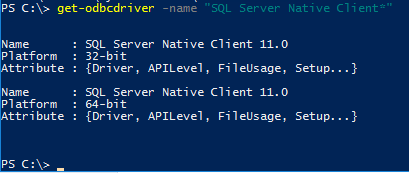
SQL Native client 11.0 should be installed on ALL MS and SQL servers (SQL 2008-2016)

From PowerShell as Administrator
get-odbcdriver -name “SQL Server Native Client*”


Example Output


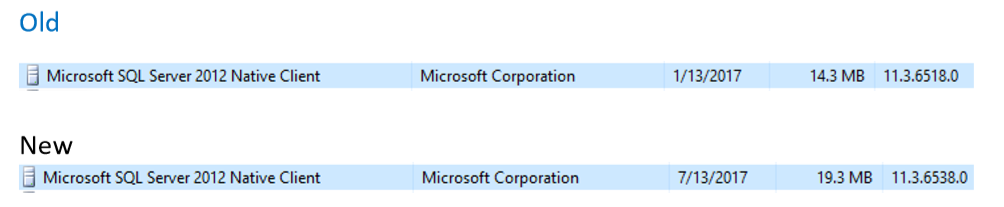
From Control Panel, Programs and Features, Installed Programs


Stop SQL Server and SQL Server agent services
Stop-service SQLSERVERAGENT

Stop-service MSSQLSERVER


Install SQL Native Client MSI

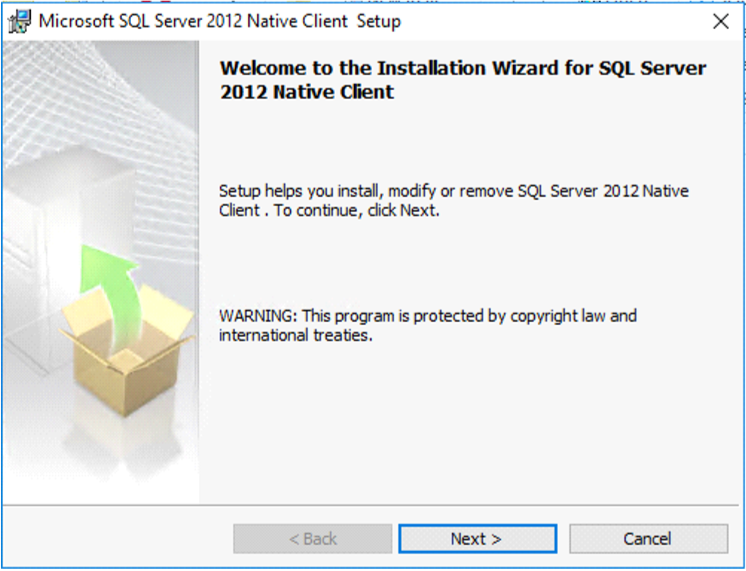
Double click on SQL Native Client MSI file to begin installation

Click on Yes to begin installation

Click Next on the Installer window


Click I accept radio button

Click Next


Click Next on Feature Selection


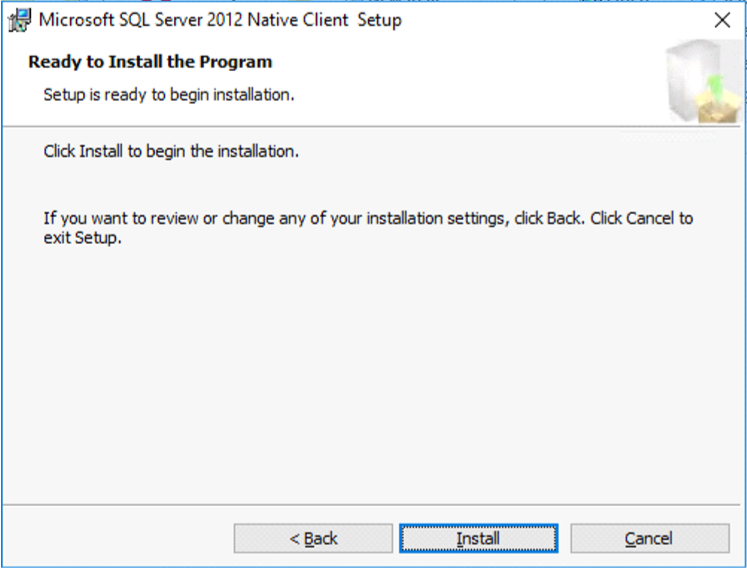
Click Install


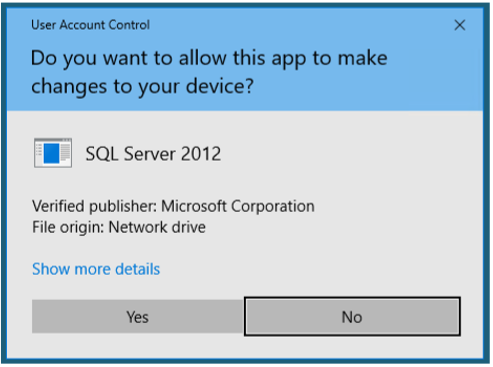
Click Yes on User Account Control (UAC) prompt


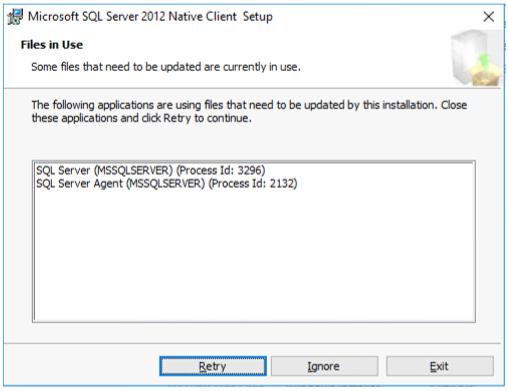
Stop SQL Server and SQL Server agent (if they restarted)


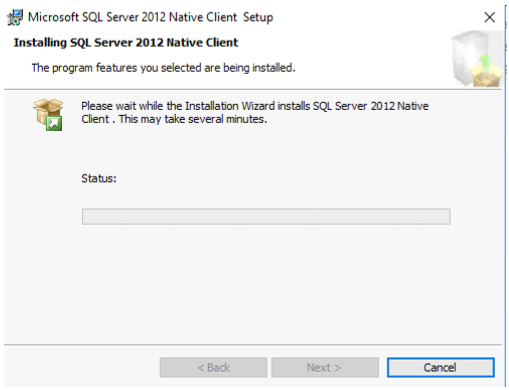
Watch installer status


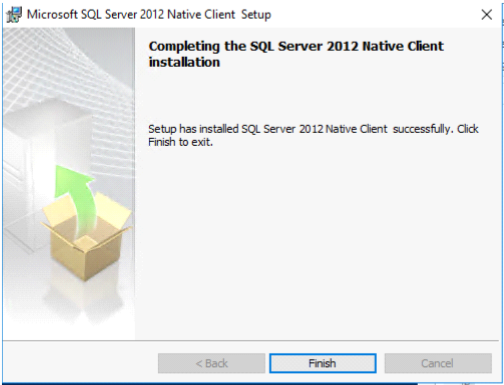
Click Finish when complete


Verify SQL Native Client Verification

Verify SQL services are running
Stop SQL Server and SQL Server agent services From PowerShell as Admin
Get-service SQLSERVERAGENT

Get-service MSSQLSERVER

From PowerShell as Admin If necessary, start SQL Server and SQL Server agent services
Start-service SQLSERVERAGENT

Start-service MSSQLSERVER
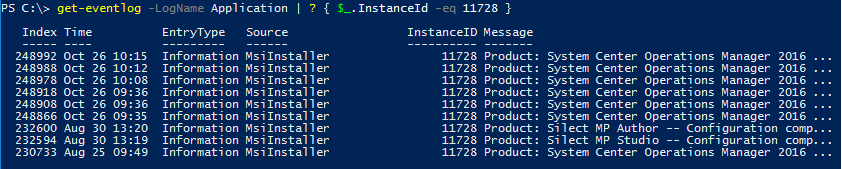
Verify Installer completed
In Event Viewer, Windows Logs, Application look for event 11728


From PowerShell

Get-EventLog -LogName Application | ? { $_.InstanceId -eq 11728 }

Rinse and Repeat for other MS and SQL servers in environment


Install ODBC on all Management Servers


For SCOM & SM, ODBC 11.0 or ODBC 13.0 should be installed on all MS and SQL servers


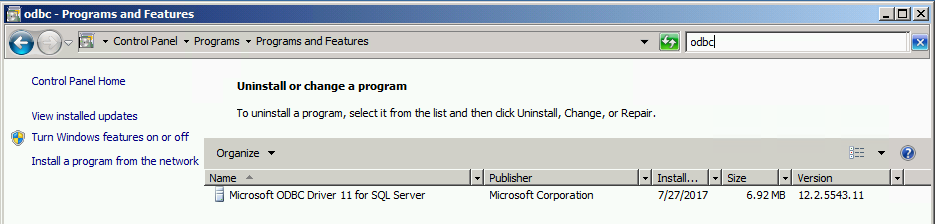
Verify ODBC v11 for server win2k8R2

From Control Panel

Click on Programs

Click on Programs and Features

Search for ODBC


Verify ODBC v13 for Server 2016

Verify version from PowerShell (run as administrator NOT required)
get-odbcdriver -name “ODBC Driver * SQL Server”


Output

Download and install appropriate version

11.0: https://www.microsoft.com/en-us/download/details.aspx?id=36434 (Version 2.0.5543.11)
13.0: https://www.microsoft.com/en-us/download/details.aspx?id=50420
Verify Installer completed
In Event Viewer, Windows Logs, Application look for event 11728


From PowerShell

Get-EventLog -LogName Application | ? { $_.InstanceId -eq 11728 } | ? { $_.Message -like “*Microsoft ODBC*”


Output


NOTE Please make sure servers are patched with latest Monthly Rollup Updates

Had issue where KB3080079 was NOT installed on server.  Patch applied to Win7, Server 2008,2008R2

From Powershell

get-hotfix -id KB3080079


Output


Install SCOM 2016 UR4 update

See Kevin Holman’s UR4 install blog https://blogs.technet.microsoft.com/kevinholman/2017/10/28/ur4-for-scom-2016-step-by-step/


Time to enable TLS1.2 Secure Channel messages on MS and SQL server (gateway if installed in your environment)

See Gallery for add/query/remove registry keys


Add SCHANNEL path for TLS

$ProtocolList       = @(“SSL 2.0″,”SSL 3.0″,”TLS 1.0”, “TLS 1.1”, “TLS 1.2”)
$ProtocolSubKeyList = @(“Client”, “Server”)
$DisabledByDefault = “DisabledByDefault”
$Enabled = “Enabled”
$registryPath = “HKLM:\\SYSTEM\CurrentControlSet\Control\SecurityProviders\SCHANNEL\Protocols\”

foreach($Protocol in $ProtocolList)
{
    Write-Host ” In 1st For loop”
foreach($key in $ProtocolSubKeyList)
{
$currentRegPath = $registryPath + $Protocol + “\” + $key
Write-Host ” Current Registry Path $currentRegPath”

if(!(Test-Path $currentRegPath))
{
    Write-Host “creating the registry”
New-Item -Path $currentRegPath -Force | out-Null
}
if($Protocol -eq “TLS 1.2”)
{
    Write-Host “Working for TLS 1.2”
New-ItemProperty -Path $currentRegPath -Name $DisabledByDefault -Value “0” -PropertyType DWORD -Force | Out-Null
New-ItemProperty -Path $currentRegPath -Name $Enabled -Value “1” -PropertyType DWORD -Force | Out-Null

}
else
{
    Write-Host “Working for other protocol”
New-ItemProperty -Path $currentRegPath -Name $DisabledByDefault -Value “1” -PropertyType DWORD -Force | Out-Null
New-ItemProperty -Path $currentRegPath -Name $Enabled -Value “0” -PropertyType DWORD -Force | Out-Null
}
}
}


# Tighten up the .NET Framework
$NetRegistryPath = “HKLM:\SOFTWARE\Microsoft\.NETFramework\v4.0.30319”
 New-ItemProperty -Path $NetRegistryPath -Name “SchUseStrongCrypto” -Value “1” -PropertyType DWORD -Force | Out-Null

$NetRegistryPath = “HKLM:\SOFTWARE\WOW6432Node\Microsoft\.NETFramework\v4.0.30319”
 New-ItemProperty -Path $NetRegistryPath -Name “SchUseStrongCrypto” -Value “1” -PropertyType DWORD -Force | Out-Null


Restart servers


Verify SCOM Console for alerts and connectivity


Adding UNIX agents via PowerShell

First, a shout out to Vanessa Bruwer @VanessaBruwer and Tyson Paul for their help!


Feel like I was pounding rocks, and had a great find! 🙂

…How to add UNIX agents manually via command line


Required

1. Unix Agent action account and agent maintenance account ID and passwords
2. Unix Resource Pool name (use get-SCOMResourcePool)

Don’t confuse the WSMAN login and use your MSAA ID

BTW, cmdlets exist with 2012R2 and 2016


From MS running PowerShell as admin

$MyPool = Get-SCOMResourcePool “UNIX/Linux Monitoring Resource Pool”
$SSHCredential = Get-SCXSSHCredential -UserName scom -ElevationType sudo
$WSCredential = Get-Credential scom

# Using MSAA account this fails

$DiscResult = Invoke-SCXDiscovery -Name “ubuntu.testlab.net” -ResourcePool $MyPool -WSManCredential $WSCredential -SSHCredential $SSHCredential

# Alternative Discovery for Network IP range
$DiscResult = Invoke-SCXDiscovery -IPRange 192.168.1.50,192.168.1.75  -ResourcePool $MyPool -WSManCredential $WSCredential -SSHCredential $SSHCredential


$DiscResult |fl -property *


$installResult = Install-SCXAgent -DiscoveryResult $DiscResult -Verbose
$installResult | fl -property *


Using MSAA account this fails


Using SCOM Agent Maintenance Account


Console verified


Resources
Old https://blogs.msdn.microsoft.com/scxplat/2009/12/11/cross-platform-powershell-scripts-released/
2012R2 (tested on my 2016 lab) https://operatingquadrant.com/2012/12/06/using-powershell-for-automated-unixlinux-agent-discovery/
PoSH cmdlet reference https://docs.microsoft.com/en-us/previous-versions/system-center/powershell/system-center-2012-r2/hh545212(v=sc.20)


MPViewer reloaded

The previous post covered the MPViewer 2012 version here


Jan Van Meirvenne spent the time to update the functionality even further

MPViewer “2012 Reloaded (release 1)” http://scug.be/jan/2016/06/06/mp-viewer-2012reloaded/


Use MPViewer reloaded will allow you to

  1. Open multiple management pack files (MP and MPB)
  2. See Modules to view underlying scripts (always wondering how a monitor got its state or property bag info)
  3. Load files from Management Group (typically this required command line or Silect MP Studio!)
  4. OpenWith file association (load MPViewer when clicking on files in explorer)

Using MP Viewer to unseal or export MP to XLS or HTML

Use MPViewer and open the management pack files (MP and MPB)


Updated 14 Dec 2018


Thanks to Daniele Muscetta for converting this so many years ago!

MPViewer tool originally at this blog https://blogs.msdn.microsoft.com/dmuscett/2012/02/19/boriss-opsmgr-tools-updated/

MPViewer v2.3.3 added to TechNet Gallery for download here


Jan Van Meirvenne spent the time to update the functionality even further

MPViewer “2012 Reloaded (release 1)” http://scug.be/jan/2016/06/06/mp-viewer-2012reloaded/


Load Management pack

GUI

In MPViewer,

Click on File, Load Management Pack

The 2012 Reloaded MPViewer allows you to open multiple management packs, or from a Management group


Go to your directory where you saved the UNIX SCOM 2016 UR2 management packs

If necessary, change the dropdown to mpb


Command line options

.\MPViewer.exe –help

Example syntax above

Remember to encapsulate your paths with quotes to be successful!

Opens MP and saves as HTML

.\MPViewer.exe “MP Path and file name” “Outputfilename.html”

Opens MP and saves as XLS

.\MPViewer.exe “MP Path and file name” “Outputfilename.xls”


Best practice is to keep same naming convention – makes it easier to track down the original MP

Example export MP to XLS

.\MPViewer.exe “S:\MonAdmin\scom\Management packs\sql\v7.0.7.0\2008-2012\Microsoft.SQLServer.2012.Monitoring.mp” “S:\MonAdmin\scom\Management packs\sql\v7.0.7.0\2008-2012\Microsoft.SQLServer.2012.Monitoring.xls”

Output

PS C:\Users\scomadmin\desktop> .\MPViewer.exe “S:\MonAdmin\scom\Management packs\sql\v7.0.7.0\2008-2012\Microsoft.SQLServer.2012.Monitoring.mp” “S:\MonAdmin\scom\Management packs\sql\v7.0.7.0\2008-2012\Microsoft.SQLServer.2012.Monitoring.xls”

PS C:\Users\scomadmin\desktop> gci “S:\MonAdmin\scom\Management packs\sql\v7.0.7.0\2008-2012\*.xls”

Directory: S:\MonAdmin\scom\Management packs\sql\v7.0.7.0\2008-2012

Mode                LastWriteTime         Length Name
—-                ————-         —— —-
-a—-       12/13/2018   8:40 AM         527618 Microsoft.SQLServer.2012.Monitoring.xls


To unseal MP to view in Notepad++


Once MP is loaded

Click File

Click Unseal MP (my path defaults to desktop)

Open file in Notepad++ or XML Editor, or your favorite XML viewer of choice


To export a management pack to XLS

Once MP is loaded

Click File

Click Save to Excel (my path defaults to desktop)


Choose path

My personal preference is to append filename with XLS for visibility


Copy file to a machine with Excel installed


Open the XML file in Excel, and hide all tabs but the Monitor tabs, and rules tab

Turn on auto-filter, etc.


Sealing SCOM MP’s


Sealing MP’s

This is an updated version of Kevin Holman’s blog, and Jonathan Almquist’s blog for SCOM2012R2 and 2016


First why seal?

If you seal the MP – we will be able to use the classes/groups created for overrides in any other override MP.

Unsealed MP – any overrides you use for classes/groups will be forced into this same MP.


If you don’t have Visual Studio 2013 and above with VSAE, or have other requirements, you will need to download the SDK to get the SN.exe utility


Download SDK

Win2008 & R2 SDK No longer available for Download

Win2012 & R2 SDK Download

Win10 SDK Download https://developer.microsoft.com/en-US/windows/downloads/windows-10-sdk

Release blog https://blogs.windows.com/buildingapps/2017/05/11/windows-10-sdk-preview-build-16190-released/

NOTE Install path to go grab the sn.exe file


Install SDK

Copy file to the local machine

Open PowerShell window as administrator

cd $HOME/desktop

.\sdksetup.exe          # .\winsdksetup.exe for Server 2016/win10


Verify SN.exe is found after SDK install completes

Server 2008 – sn.exe located in C:\Program Files\Microsoft SDKs\Windows\v6.1\Bin\x64

Server 2012 – sn.exe located in C:\Program Files (x86)\Microsoft SDKs\Windows\v8.1A\bin\NETFX 4.5.1 Tools

Server 2016 and Win 10 – sn.exe located in C:\Program Files (x86)\Microsoft SDKs\Windows\v8.0A\bin\NETFX 4.0 Tools


Create the MPSeal folders

Repository where you want to keep the MPSeal.exe, SNK files, and related sealed packs for any MP sealed
C:\monadmin\MPSeal
C:\monadmin\MPSeal\unsealed
C:\monadmin\MPSeal\sealed # Reference sealed MP’s
C:\monadmin\MPSeal\key
C:\monadmin\MPSeal\output

PowerShell as Admin commands to create repository

new-item -itemtype directory -path c:\monadmin\
new-item -itemtype directory -path c:\monadmin\MPSeal
new-item -itemtype directory -path c:\monadmin\MPSeal\unsealed
new-item -itemtype directory -path c:\monadmin\MPSeal\sealed
new-item -itemtype directory -path c:\monadmin\MPSeal\key
new-item -itemtype directory -path c:\monadmin\MPSeal\output


Copy MPSeal utility from Support directory on SCOM ISO

On ISO, copy mpseal* from ISO SupportTools\AMD64 directory to c:\monadmin\MPSeal


Let’s get the Key file generated and start sealing MP’s!


Create SNK files
Note SN.exe only needs to be run once to create the SNK file
***Critical note – you need to keep a backup of this key… because it will be required for making updates to this MP in the future, re-sealing, and keeping the ability to upgrade the existing MP in production.


sn -k <yourDomainNameHere>.snk

Sample syntax from win2k8 server

Copy this SNK file to c:\monadmin\MPSeal\key


Copy Referenced MP’s
This is a good opportunity to add the MP’s referenced in the ISO, UR updates, and/or RTM folder when installing SCOM, Unix MP’s, etc.

Copy sealed MP’s to c:\monadmin\MPSeal\sealed


Seal MP

MPSeal.exe c:\monadmin\mpseal\unsealed\<mpNameHere>.xml /I “c:\monadmin\mpseal\sealed” /Keyfile “c:\monadmin\mpseal\key\PairKey.snk” /Company “CompanyName” /Outdir “c:\monadmin\mpseal\output”


References
How to Seal MP https://docs.microsoft.com/en-us/previous-versions/system-center/system-center-2012-R2/hh457550(v=sc.12)


SCOM Maintenance Mode PowerShell

My thanks to Matt Taylor and Kevin Holman, Ralph Kyttle, and John Kavanagh for their guidance!

Updated 24 Jun 2022


Read on if these apply
Trying to start, update, or end SCOM MM

Get alerts when MM is updated
PowerShell only in your shop!
SCORCH in play but need to convert runbooks to straight PowerShell

Ran into issues using Set-SCOMMaintenanceMode, as the cmdlet doesn’t put ALL the recursive classes under Windows Computer


Background

Set-SCOMMaintenanceMode cmdlet is actually “by design.”  ☹


Start-SCOMMaintenanceMode assumes you want recursive action when you start maintenance mode….

Pick a Windows Computer and it places the Windows Computer object (AND all contained objects) into MM.


Computer in MM

All contained objects in MM


However, the problem is that Set-SCOMMaintenancemode does not have an understanding of recursiveness.

Command changes the MM entry for the Windows Computer, but NOT all the contained objects.  So they retain the original setting.


Health explorer looks like this, resulting in unwanted alerts


Details

NOTE these $Time and DateTime Method are dependent on the delay between running the commands
If you start MM, and wait 5 minutes, then update, the total MM duration will be ~20 minutes


Maintenance Mode options and examples

# Setup variables for MM

# Example 1 Windows Computer

$server = “Servername.FQDN”

$instance = (get-scomclass -DisplayName “Windows Computer” |Get-SCOMClassInstance | where { $_.DisplayName -eq $server } )

# Set time for 6 minutes

$Time = (Get-Date).addMinutes(6)

Start-SCOMMaintenanceMode -Instance $Instance -EndTime $Time -Comment “Starting Maintenance Mode.” -Reason “PlannedOther”


# Example 2

# Business needs require Windows Operating System monitoring to occur while Application is in maintenance

# My Example is Defender, could be SQL, MSMQ, Lync, Skype, or your custom class created for your application

$Class = (get-scomclass)
$Class | ? { $_.Name -like “*Defender*” } | fl DisplayName,Name

DisplayName : Protected Endpoint
Name        : Microsoft.WindowsDefender.ProtectedServer

DisplayName : Protected Candidate
Name        : Microsoft.WindowsDefender.ProtectedServerCandidate

DisplayName : Unprotected Endpoint
Name        : Microsoft.WindowsDefender.UnprotectedServer

DisplayName : Microsoft Windows Defender Class
Name        : Microsoft.Windows.Defender.Class

# Choose the class needed

$server = “Servername.FQDN”

$instance = ( $Class | ? { $_.Name -like “Microsoft.Windows.Defender*” } |Get-SCOMClassInstance | ? { $_.DisplayName -eq $server } )

# Verify Instance variable

$instance

PS C:\Users\scomadmin> $instance

HealthState     InMaintenanceMode  DisplayName
———–     —————–  ———–
Success               False        WFM.testlab.net


# Don’t forget to add time variable

$Time = (Get-Date).addMinutes(6)

# Start maintenance mode

Start-SCOMMaintenanceMode -Instance $Instance -EndTime $Time -Comment “Starting Maintenance Mode.” -Reason “PlannedOther”


Start, Update, End and Verify Maintenance mode syntax


# Start MM via PoSH cmdlet

Start-SCOMMaintenanceMode -Instance $Instance -EndTime $Time -Comment “Starting Maintenance Mode.” -Reason “PlannedOther”


# Start MM using method vs. PowerShell cmdlet

Note Recursive in $WCobj.ScheduleMaintenanceMode

$windowsComment=”PlannedOther”
$windowReason=”PlannedOther”
$windowsComment=”Testing Maintenance Mode”
$windowDuration=15

$server= “wfm.testlab.net”
$instance = (get-scomclass -DisplayName “Windows Computer” |Get-SCOMClassInstance | ? { $_.DisplayName -eq $server } )
$instance.ScheduleMaintenanceMode([datetime]::Now.touniversaltime(),([datetime]::Now).addminutes($windowDuration).touniversaltime(), “$windowReason”, “$windowsComment” , “Recursive”)

# Drop Recursive if you don’t want it (but can’t imagine why you would!)


# Update MM

# Make sure you’ve put object in MM

$server= “wfm.testlab.net”
$instance = (get-scomclass -DisplayName “Windows Computer” |Get-SCOMClassInstance | ? { $_.DisplayName -eq $server } )

# 15 minutes in the future
$instance.UpdateMaintenanceMode([System.datetime]::Now.touniversaltime().addminutes(15),[Microsoft.EnterpriseManagement.Monitoring.MaintenanceModeReason]::PlannedOther,[System.string]::”Adding 15 minutes to the end time.”,[Microsoft.EnterpriseManagement.Common.TraversalDepth]::Recursive);


# Stop MM

# Make sure you’ve put object in MM

# Immediate
$instance.StopMaintenanceMode([System.DateTime]::Now.ToUniversalTime());

My thanks to Jan Nevaril

$server.StopMaintenanceMode([System.DateTime]::Now.ToUniversalTime(),“Recursive”)


Verification steps


# Verify MM

get-scommaintenancemode -ComputerName $instance.Name|fl MonitoringObjectId,StartTime,ScheduledEndTime

NOTE This will error if you’ve stopped maintenance

Example

PS C:\Users\scomadmin> get-scommaintenancemode -ComputerName $instance.Name
get-scommaintenancemode : The Data Access service is either not running or not yet initialized. Check the event log
for more information.
At line:1 char:1
+ get-scommaintenancemode -ComputerName $instance.Name
+ ~~~~~~~~~~~~~~~~~~~~~~~~~~~~~~~~~~~~~~~~~~~~~~~~~~~~
+ CategoryInfo          : InvalidOperation: (Microsoft.Syste…anceModeCommand:GetSCMaintenanceModeCommand) [Get-S
COMMaintenanceMode], ServiceNotRunningException
+ FullyQualifiedErrorId : ExecutionError,Microsoft.SystemCenter.OperationsManagerV10.Commands.GetSCMaintenanceMode
Command


# Validate MM through Operations Manager Event ID’s 1215 and 1216 logged

get-eventlog -LogName “Operations Manager” | ? { $_.EventID -eq 1215 -OR $_.EventID -eq 1216 } |fl EventID,TimeGenerated,Message

# Alternate command to check latest 100 events

get-eventlog -LogName “Operations Manager” -newest 100 | ? { $_.EventID -eq 1215 -OR $_.EventID -eq 1216 } |fl EventID,TimeGenerated,Message


# Error if object NOT in MM

Cannot find an overload for “UpdateMaintenanceMode” and the argument count: “1”.

At line:1 char:1

+ $WCobj.UpdateMaintenanceMode(([System.datetime]::Now).addminutes(15). …

+ ~~~~~~~~~~~~~~~~~~~~~~~~~~~~~~~~~~~~~~~~~~~~~~~~~~~~~~~~~~~~~~~~~~~~~

    + CategoryInfo          : NotSpecified: (:) [], MethodException

    + FullyQualifiedErrorId : MethodCountCouldNotFindBest


PS C:\Windows\system32>


Testing System datetime

PS C:\Windows\system32> [System.datetime]::Now.addminutes(15)


Thursday, August 24, 2017 9:18:04 AM


PS C:\Windows\system32> ([System.datetime]::Now.addminutes(15)).touniversaltime()


Thursday, August 24, 2017 2:18:16 PM


References

2012 PowerShell cmdlets https://docs.microsoft.com/en-us/previous-versions/system-center/hh920227(v=sc.20)

2016 PowerShell cmdlets https://docs.microsoft.com/en-us/powershell/module/operationsmanager/?view=systemcenter-ps-2016

2019 PowerShell cmdlets https://docs.microsoft.com/en-us/powershell/module/operationsmanager/?view=systemcenter-ps-2019

SDK

Ralph Kyttle Blog https://blogs.technet.microsoft.com/ralphkyttle/2014/11/10/scom-2012-r2-use-powershell-to-end-an-active-maintenance-mode/

DateTime Methods https://docs.microsoft.com/en-us/dotnet/api/system.datetime

SCOM 2019 Maintenance Mode
https://docs.microsoft.com/en-us/system-center/scom/manage-maintenance-mode-overview?view=sc-om-2019

MSDN MaintenanceModeReason Method https://docs.microsoft.com/en-us/previous-versions/system-center/developer/bb465591(v=msdn.10)

MSDN StopMaintenanceMode Method

UpdateMaintenanceMode Method https://docs.microsoft.com/en-us/previous-versions/system-center/developer/bb424495(v=msdn.10)


MM deluxe custom script https://gist.github.com/stegenfeldt/b3f044aa77894ed80d82f8849a48035b

Clarification on Registry Key discoveries


Ran across this in my travels, difficulty getting a monitor to work properly

To clarify some of the registry MP fragments, make sure you follow the whole path

This post is to help with using the Monitor.RegistryValue.Exists.mpx fragment


Example – Verify Registry Key under TestService


This is an excerpt from the MP Fragment header

%%
Description:
    This fragment includes a Monitor which checks for the existence of a registry VALUE
 RegValuePath – needs to be in the format of “SOFTWARE\Microsoft\CCM\HttpPort” or “SYSTEM\CurrentControlSet\Services\CcmExec\Start” as HKLM is assumed
 RegValueName – needs to be the actual Reg VALUE name or your description of it (NO SPACES or special characters allowed) such as “HttpPort”
Version: 1.1
LastModified: 29-May-2017
%%

In the MP Fragment, you substitute the variables

<AttributeName>##RegValueName##</AttributeName>
<Path>##RegValuePath##</Path>

<AttributeName>ObjectName</AttributeName>
<Path>SYSTEM\SysInfo\AppName</Path>


Registry Key = HKLM\SYSTEM\CurrentControlSet\Services\HealthService\Test

Fragment variable (##RegValueName##) = SYSTEM\CurrentControlSet\Services\HealthService\Test

AttributeName or ##RegValueName## is simply whatever you want to call the attribute

Simply the name of the Registry value for my example is Test

Substitute ##RegValueName## for Test


If you’re testing in the lab, decrease frequency so you don’t have to wait as long

<Frequency>120</Frequency>

Remember to increase the frequency when you’re done


Upload MP (don’t forget to version your pack!)


Watch Health Explorer and test away adding or removing your key


Helpful testing tips to add a key to the registry and flip the health

reg add “HKLM\System\CurrentControlSet\Services\TestService” /v “Test” /t REG_SZ /d Test

reg delete “HKLM\System\CurrentControlSet\Services\TestService” /v “Test”


Use DWdataRP utility on SCOM2016

Extra, Extra, read all about it!   Updated 24 June 2022

The DWdataRP utility works on SCOM2016+ 


This tool has been around since SCOM 2007, and blogged about by Kevin Holman and the SCOM Engineering Team

DW Retention https://kevinholman.com/2010/01/05/understanding-and-modifying-data-warehouse-retention-and-grooming/

Kevin added these –

Here is a link to the original command line tool, DWDATARP:   https://kevinholman.com/files/dwdatarp.zip

Here is a tool which makes this even simpler:  https://www.scom2k7.com/scom-datawarehouse-grooming-settings-super-easy-with-new-gui-tool/

And the latest new tool which adds features and simplicity, which is what I recommend: https://blakedrumm.com/blog/scom-dw-grooming-tool/


DWDataRP https://techcommunity.microsoft.com/t5/System-Center-Blog/Data-Warehouse-Data-Retention-Policy-dwdatarp-exe/ba-p/340415?search-action-id=139683980150&search-result-uid=340415


Download the link at the second link, and save to your machine (x86 or x64)


Run the executable

dwdatarp.exe -s <DB Server Name> -D <DW Database Name>


Example dwdatarp.exe -s 16DB02 -D OperationsManagerDW


Set Data sets according to SLA


Ever need to shorten up your Lab DB, so you can export it, to leverage PowerBI dashboards?


Example Output

PS C:\Users\sqladmin\Documents\DWDataRP\amd64> .\dwdatarp.exe -s 16db02.testlab.net -d OperationsManagerDW
Dataset name Aggregation name Max Age Current Size, Kb
—————————— ——————– ——- ——————–
Alert data set Raw data 180 28,736 ( 0%)
Client Monitoring data set Raw data 30 0 ( 0%)
Client Monitoring data set Daily aggregations 400 136 ( 0%)
Configuration dataset Raw data 400 259,968 ( 3%)
DPM event dataset Raw data 400 0 ( 0%)
DPM.Backup.DataSet Raw data 400 0 ( 0%)
DPM.Backup.DataSet Hourly aggregations 3 0 ( 0%)
DPM.Backup.DataSet Daily aggregations 182 0 ( 0%)
DPM.DiskMgmt.DataSet Raw data 400 0 ( 0%)
DPM.DiskMgmt.DataSet Hourly aggregations 3 0 ( 0%)
DPM.DiskMgmt.DataSet Daily aggregations 182 0 ( 0%)
DPM.DiskUtilization.DataSet Raw data 400 0 ( 0%)
DPM.DiskUtilization.DataSet Hourly aggregations 3 0 ( 0%)
DPM.DiskUtilization.DataSet Daily aggregations 182 0 ( 0%)
DPM.Recovery.DataSet Raw data 400 0 ( 0%)
DPM.Recovery.DataSet Hourly aggregations 3 0 ( 0%)
DPM.Recovery.DataSet Daily aggregations 182 0 ( 0%)
DPM.SLATrend.DataSet Raw data 400 0 ( 0%)
DPM.SLATrend.DataSet Hourly aggregations 3 0 ( 0%)
DPM.SLATrend.DataSet Daily aggregations 182 0 ( 0%)
DPM.TapeUtilization.DataSet Raw data 400 0 ( 0%)
DPM.TapeUtilization.DataSet Hourly aggregations 3 0 ( 0%)
DPM.TapeUtilization.DataSet Daily aggregations 182 0 ( 0%)
Event data set Raw data 100 456,144 ( 5%)
Exchange 2013: Mailbox Database data warehouse dataset Raw data 30 0 ( 0%)
Exchange 2013: Mailbox statistics data warehouse dataset Raw data 30 0 ( 0%)
Exchange 2013: Mailbox statistics data warehouse dataset Daily aggregations 400 0 ( 0%)
Performance data set Raw data 10 216,096 ( 2%)
Performance data set Hourly aggregations 400 5,552,832 ( 61%)
Performance data set Daily aggregations 400 221,312 ( 2%)
Process Monitoring: Performance Metric State data warehouse dataset Raw data 10 0 ( 0%)
Process Monitoring: Performance Metric State data warehouse dataset Hourly aggregations 90 0 ( 0%)
Process Monitoring: Performance Metric State data warehouse dataset Daily aggregations 180 0 ( 0%)
Process Monitoring: Process Health State data warehouse dataset Raw data 10 0 ( 0%)
Process Monitoring: Process Network Ports data warehouse dataset Raw data 10 0 ( 0%)
State data set Raw data 180 6,080 ( 0%)
State data set Hourly aggregations 400 2,335,968 ( 25%)
State data set Daily aggregations 400 99,840 ( 1%)


Commands to run to clean up the warehouse…

.\dwdatarp.exe -s 16db02.testlab.net -d OperationsManagerDW -ds Performance -a Hourly -m 60
.\dwdatarp.exe -s 16db02.testlab.net -d OperationsManagerDW -ds State -a Hourly -m 60
.\dwdatarp.exe -s 16db02.testlab.net -d OperationsManagerDW -ds event -a raw -m 30

Example Output
PS C:\Users\admin\Documents\DWDataRP\amd64> .\dwdatarp.exe -s 16db02.testlab.net -d OperationsManagerDW -ds Performan
ce -a Hourly -m 60
Max data age set to 60 on dataset “Performance data set” aggregation type “Hourly aggregations”
PS C:\Users\admin\Documents\DWDataRP\amd64> .\dwdatarp.exe -s 16db02.testlab.net -d OperationsManagerDW -ds State -a
Hourly -m 60
Max data age set to 60 on dataset “State data set” aggregation type “Hourly aggregations”
PS C:\Users\admin\Documents\DWDataRP\amd64> .\dwdatarp.exe -s 16db02.testlab.net -d OperationsManagerDW -ds event -a
raw -m 30
Max data age set to 30 on dataset “Event data set” aggregation type “Raw data”


Don’t forget to execute cleanup

–This will manually run grooming for this dataset
DECLARE @DatasetId uniqueidentifier
SET @DatasetId = (SELECT DatasetId FROM StandardDataset WHERE SchemaName = ‘Alert’)
EXEC StandardDatasetGroom @DatasetId

–This will manually run grooming for this dataset
DECLARE @DatasetId uniqueidentifier
SET @DatasetId = (SELECT DatasetId FROM StandardDataset WHERE SchemaName = ‘Event’)
EXEC StandardDatasetGroom @DatasetId

–This will manually run grooming for this dataset
DECLARE @DataSetId uniqueidentifier
SET @DataSetId = (SELECT DatasetId FROM StandardDataset WHERE SchemaName = ‘Perf’)
EXEC StandardDatasetGroom @DataSetId

–This will manually run grooming for this dataset
DECLARE @DataSetId uniqueidentifier
SET @DataSetId = (SELECT DatasetId FROM StandardDataset WHERE SchemaName = ‘State’)
EXEC StandardDatasetGroom @DataSetId